
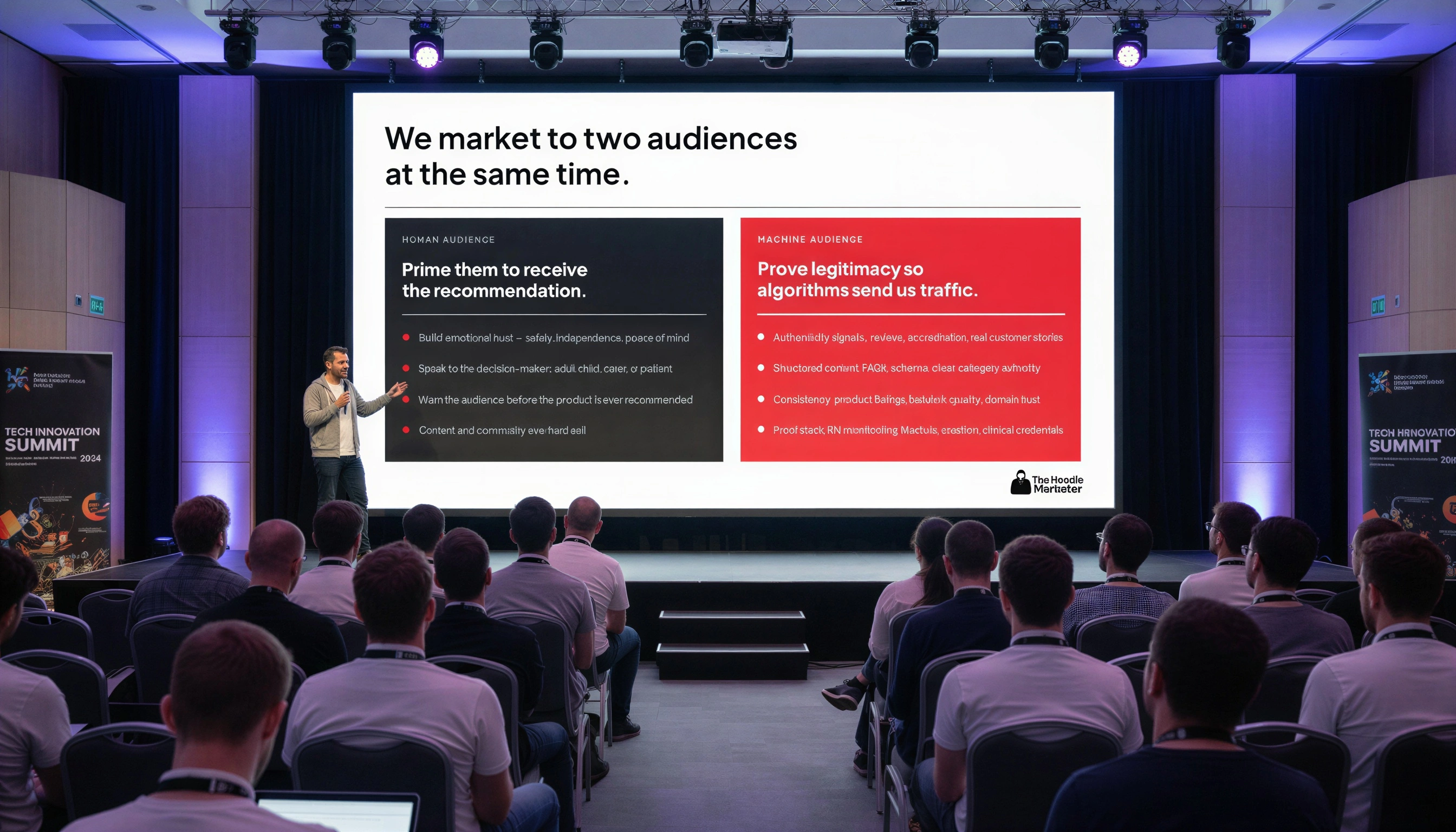
There’s a slide I built for a presentation this week, that says something simple: we market to two audiences at the same time. One is human. One is a machine. The human audience needs to be primed, warmed up and have a level of trust, before it ever sees a recommendation. The machine audience needs to be proven to, given the authenticity signals and structured content it needs to decide our brand is legitimate enough to send its own audience our way. I built that slide as an explanation of where I think marketing strategy needs to sit right now. Then I heard Jonathan Mildenhall, Rocket’s CMO, describe almost the same split about a company managing $2.1 trillion in mortgages, and realised it isn’t just a gut feel. It’s the shape of marketing now, and lean teams are the ones least resourced to run it, and most in need of a plan for it.
Two audiences, one budget
On a recent episode of Fast Company’s Brand New World, Mildenhall told host Jeff Beer that “the traditional marketing funnel only speaks to one audience, and that audience is human beings. Today, we have two audiences that need to be served simultaneously: we have human beings… and we have machines that need authority, trust, and industry leadership.” His conclusion was blunt: no CMO of note should still be running go-to-market off a funnel built for one audience.
Rocket has the scale to act on that immediately. One in six American mortgages now runs through the business, there’s an in-house creative team building for both audiences at once, and the stated goal is the world’s first AI-fuelled home ownership platform. When Mildenhall says brand investment and performance investment will finally “honour the same idea,” he’s describing a company that can fund both audiences properly, at the same time, without anyone feeling the trade-off.
Most of us aren’t running that company. Most of us are running marketing for something closer to a small business, a real business with a real reputation to protect, out of a team of one to five people, with a content calendar that’s already full before anyone mentions a second audience. The two-audience reality Mildenhall is describing is correct. It’s also a capacity problem for anyone without Rocket’s budget, and pretending otherwise is how lean teams end up doing a mediocre version of both.
What proving actually looks like
Proving is the audience most lean teams already half-understand, even if nobody’s ever spoken out loud. It’s the machine-facing half of the slide: authenticity signals like reviews, accreditation, and real customer stories; structured content like FAQs, schema, and clear category authority; consistency across listings and backlink quality; and a proof stack of whatever credentials genuinely apply, registrations, professional accreditation, third-party monitoring, whatever makes a machine confident this business is who it says it is.
None of that requires taste, and that’s exactly why it suits a lean team. It’s a checklist, not a campaign. Structured FAQ content with schema markup takes an afternoon to build properly, and then it keeps working for a year, cited by whichever model is answering that query this week, without anyone touching it again. Compare that to the shelf life of a brand campaign, which starts decaying the week it stops running. If a lean team only has capacity to build one durable asset this quarter, proving is where the hours return the most for the least ongoing input.
What priming still needs, and why it’s not optional
The temptation, once you see that math, is to pour everything into proving and treat priming as a nice-to-have. Mildenhall’s other warning is the reason that’s a mistake. He also told Beer, “sadly, there’s more wallpaper in marketing today than there are culturally significant stories,” and that if brands leave their content to the judgement of large language models, “they’re all reading the same categories in the same ways; we will move to a sea of blandness which will mean that so many brands will end up being destroyed because they’re not distinct.”
That’s the risk hiding inside a proving-only strategy. Structured content and schema are genuinely necessary, but they’re also exactly the kind of content every competitor in your category is now producing, because every guide on the internet, including this one, is telling them to. Optimise purely for the machine and you get a category full of brands that all read the same to the thing deciding who gets seen.
Proving is a checklist. A lean team can run a checklist well. Priming is a relationship, and a relationship doesn’t compound the same way a schema markup does.
Priming is where the human-specific work still has to happen: the actual case study with a name and a number attached to it, not a generic testimonial; the founder or CMO showing up consistently in one place rather than thinly across five; the piece of content that only makes sense coming from your specific team, which is the part no model can generate on your behalf, because it doesn’t have the story.
Where the actual hours should go
If a lean team has, say, 10 hours a week for anything that isn’t pure execution, an effective split in my experience is roughly 6 hours on proving and 4 on priming. Not because priming matters less, proving is infrastructure you build once and it keeps paying, while priming needs a steady drip to stay warm. Six hours a week on structured content and consistency signals is around 300 hours a year, this compounds quickly and can close the proving gap on a small site within one cycle. Four hours a week on priming isn’t enough to run a brand campaign, but it’s enough to keep one real story, one real relationship, one real proof point moving every single week, which is the version of priming a lean team can actually sustain without it quietly dropping off in a busy month.
The uncomfortable trade-off
Here’s the part I’d rather not have to say to a lean marketer, but it’s true: you probably can’t build both funnels to Rocket’s standard, at the same time, with the team and budget you have. Something has to go first. In my experience, unproven goes first, because a brand no machine will surface never gets the chance to prime anyone, no matter how good the story is. Prove enough to earn the traffic, then spend the priming hours making sure that traffic actually likes what it finds when it arrives. Sequencing it the other way (spending scarce hours warming up humans a machine hasn’t yet decided to show your brand to) is the way lean teams burn months without ever finding out why the numbers didn’t move.
Want to hear the full Episode?
Dom O'Brien
CMO at MATE and author of The Startup Marketing Playbook. Fifteen years building lean marketing teams that punch above their weight.
Work with Dom →