
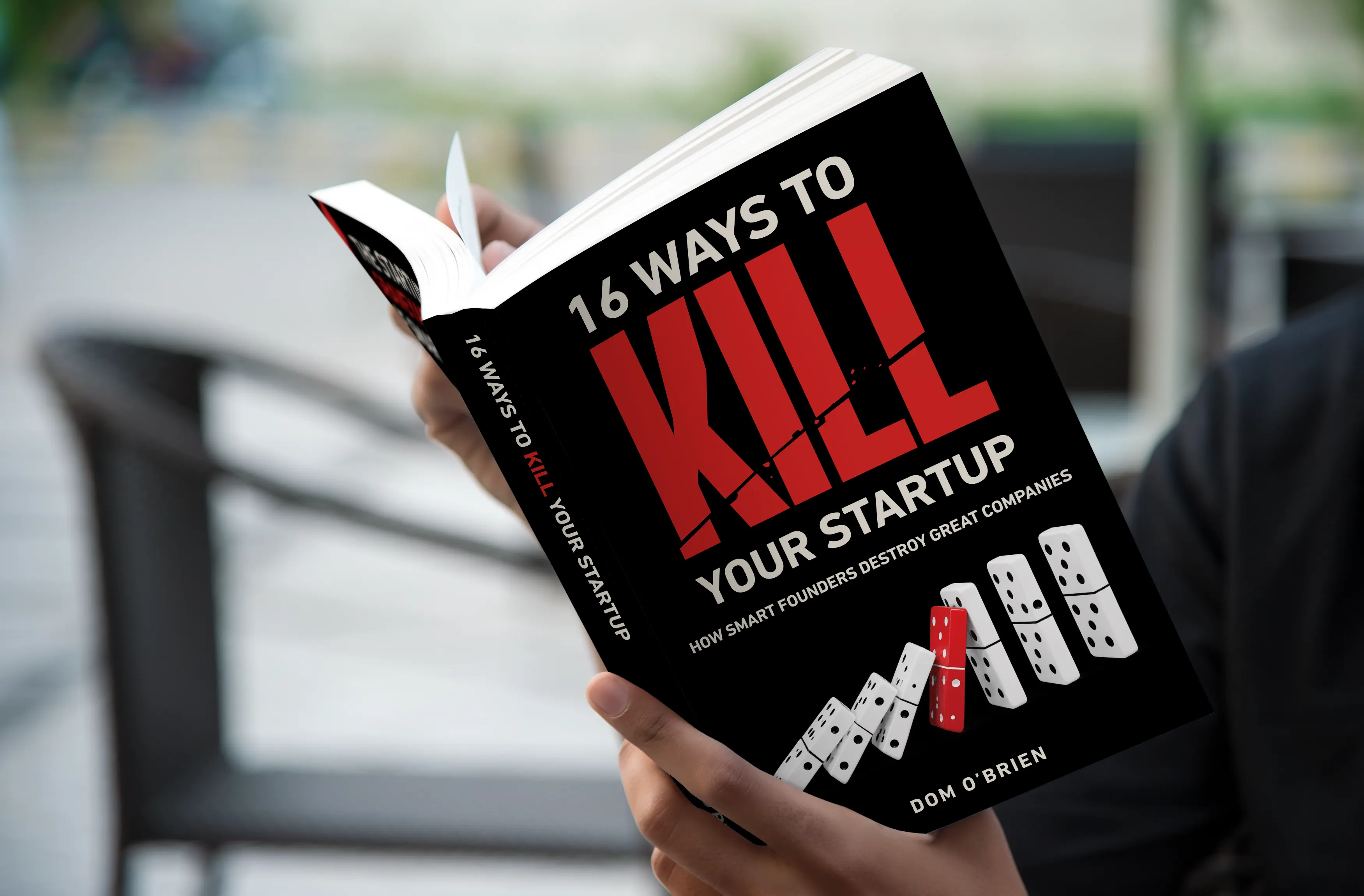
My new book, 16 Ways to Kill Your Startup, is out now in paperback and Kindle on Amazon. It didn’t start as a book. It started around 2015, with a few familiar mistakes. Over ten years it became a note on my phone, then a growing list.
This post covers why I kept adding to that list, who the book is for, and what I hope you do with it.
Why write a book about killing a startup?
Because knowing what to do isn’t the same as knowing what not to do. Most startup advice focuses on the first part. Work hard, iterate fast, listen to customers, find product-market fit. All good advice. But in the startup world, what you don’t do can kill you faster than what you do.
It started in about 2015. The businesses I had worked in or with up to that point were making similar mistakes, and they started to look like a pattern. I built on it over 10 years, and I could see the same mistakes being made by larger businesses in more public settings.
The pattern that kept showing up on my list was simple. Most startups don’t die from external forces. They don’t get killed by the economy or because “the market just wasn’t ready”. They make internal decisions that slowly (or quickly) strangle their own potential.
There’s a line in the introduction that sums up how it feels to watch it happen:
“The rake isn’t hidden. The rake isn’t sneaky. The rake is just sitting there, waiting for the next overconfident entrepreneur to come along and step on it.”
So I turned the note into a book about the rakes.
Why focus on failure stories, not success stories?
Because failure is a better teacher. Success stories are written backwards. Once a company wins, every decision it made gets reinterpreted as evidence of good judgement, including the decisions that were lucky, contested at the time, or just wrong and the mistakes often get forgotten or buried.
When a company dies, the record stays put. You can trace decisions against what happened next and ask a far more useful question: where might I be making the same mistake?
That’s why each chapter is built around a real company. WeWork, Groupon, BlackBerry, Casper, Quibi and more. Real companies, real numbers, and decisions that looked smart at the time.
Who is the book for?
It’s for founders and the people building startups alongside them. In the book I describe three likely readers:
- an aspiring entrepreneur who wants to avoid becoming a cautionary tale
- a current founder who’s starting to smell smoke and wants to know where the fire is
- someone who enjoys watching other people’s expensive mistakes from the safety of their couch (no judgement)
It’s also for the people on the inside. The book is dedicated to “everyone who has survived a startup from the inside”. If you’re a marketer or operator in a lean team, you’ll recognise a lot of these patterns, and you’re often the first person to see them coming.
This book was the first I started, but I put it on hold to help lean marketers with more specific strategies in The Startup Marketing Playbook, but I knew I had to come back to it, if it only helped one founder see a storm before it was brewing.
What it isn’t: It’s not a guide to raising money, writing code or building the next TikTok. It has one job, keeping your startup alive long enough to figure out the rest.
What are the 16 ways, at a high level?
They’re grouped into four potentially fatal mistakes: the people, the product, the money and the long game.
- The people. Founding teams pulling in different directions, the wrong people in the wrong roles, hiring experts and then ignoring them, and letting pride make the calls.
- The product. Building things nobody wants, over-engineering, patching problems instead of fixing them, and quietly stopping innovating.
- The money. Pricing yourself into oblivion, throwing money at problems, and treating your investor like an ATM.
- The long game. Ignoring your brand, assuming customers will just turn up, hiring fast and never firing, and changing direction every five minutes.
Some of these kill you quickly. Some are slow poison. Every one is preventable if you know what to look for.
Every chapter follows the same structure, so you can jump straight to the mistake you’re most worried about: the horror story, why this kills startups, the right way, red flags, a survival checklist, and the final nail.
The red flags section matters most to me. Recognising you’re making a mistake right now is harder than it sounds, and it’s the reason the book exists. Even then sometimes founders are too close to the problem or think that their situation is special or different enough that it wont happen to them.
Which mistake sits underneath all the others?
Not being able to accept that you might be wrong. Every founder in the book had chances to change course. The experts warned them. The data showed problems. Customers gave feedback. The board raised concerns. They doubled down anyway.
If you take one thing from the book, I’d like it to be this: stay radically open to the possibility that you’re wrong about the specific choices that matter. Build systems that help you find out quickly, not systems that help you convince yourself you’re right until it’s too late.
It’s the same reason I write about how I decide what to stop doing. Stopping is a skill, and most of us don’t practise it enough.
What do I hope readers do differently?
Use the book as a mirror, not just a good read. The easy path is to read these stories, think “that would never happen to us”, and carry on. The useful path is to spot your own warning signs early and change course quickly.
A few practical ways to do that, straight from the conclusion:
- Monthly leadership review: pick two chapters a month, go through the red flags, and be honest about whether you’re showing any of them.
- Before big decisions: review the relevant checklists. Thinking of expanding? Reread the chapters on spending and hiring.
- Team onboarding: make the relevant chapters required reading for leadership hires, so more people can spot the patterns.
If you’d like a simple way to start that kind of honest review in your own marketing function, my one-hour growth audit is a good companion piece.
Reading the book won’t guarantee your startup succeeds. You still need a good idea, solid execution, timing and a bit of luck. But it can help you fail for new and interesting reasons instead of the same boring ones.
Where can you get it?
16 Ways to Kill Your Startup is available now in paperback and Kindle on Amazon (Australia, US, UK, Germany and the Netherlands). You can read more about it on the book page.
As I put it at the end of the original note: if it helps one business, one founder avoid one of these mistakes, it was probably worth writing. If you read it, I’d love to know which chapter hit closest to home.
Dom O'Brien
CMO at MATE and author of The Startup Marketing Playbook. Fifteen years building lean marketing teams that punch above their weight.
Work with Dom →